Are You Not Getting Good Enough Results from Your Training? This May Be the Reason | Hardworkout Magazine
Key takeaways
- Building muscle requires a calorie surplus of roughly 300-500 calories above your daily needs if you want to limit fat gain at the same time.
- People who train frequently are advised to eat 1.6-2.2 g of protein per kilogram of body weight per day, spread evenly across meals.
- Progress stalls without progressive overload: gradually increasing weight, sets or repetitions, shortening rest periods or varying exercises.
- Each muscle group needs 1-2 days of recovery between sessions, and training more than 2-3 days in a row raises the risk of overtraining and injury.
- Seven to nine hours of sleep a night is recommended, and people who train a lot may need more.
There can be many reasons why you are not gaining larger muscles and achieving the results you desire from your training. Knowledge level, diet, motivation, training plan, and a plan for progression are important factors for obtaining satisfactory results.
Here we will address the 7 most important reasons why you are not gaining larger muscles and provide you with good advice on how to optimize muscle growth.
(1) You are not eating enough calories
To build muscle and generally gain weight, you need to eat more calories than you burn throughout the day.
If you want to build muscle without gaining too much extra fat, adding 300-500 extra calories beyond your caloric needs may be sufficient.
You can use various formulas or [calculators](https://www.garnethealth.org/news/basal-metabolic-rate-calculator) online that calculate your BMR (basal metabolic rate) and then estimate your caloric needs based on your activity level.
Intense workout sessions also require you to consume enough food so that you have the energy to perform and lift heavy enough to make progress.
As muscle mass increases, your resting metabolism will also increase, meaning you burn more calories without having increased your activity level.
So if you want to continue building muscle/gaining weight, you need to gradually increase your calorie intake as well.
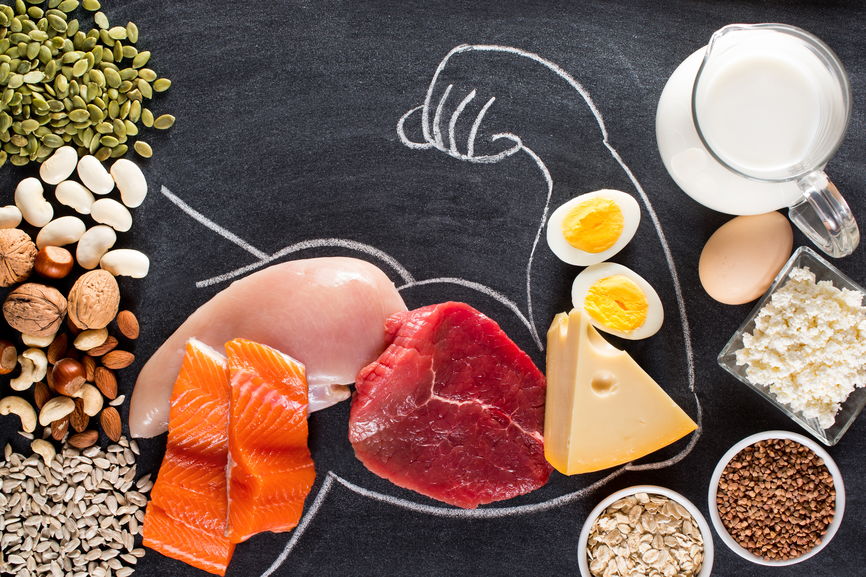
(2) You are not eating the right foods
So even though you need to ensure you are getting enough calories, it does not mean that those calories can come from anything.
The body needs the right fuel to gain energy, and the muscles need the right building blocks to grow.
For muscle growth, it is primarily important to eat enough protein.
Choose lean protein sources of high quality such as chicken, turkey, fish, lean meat, low-fat dairy products, and eggs.
It can also be beneficial to use protein powder to ensure that you get enough protein throughout the day.
After training, it is recommended to consume proteins that are absorbed quickly ([whey](/magazine/protein-powder-best-in-test-2026-top-10-protein-powders)), while in the evening before going to bed, proteins that are absorbed slowly (casein) are recommended.
You can also buy protein powder that is a blend of fast and slow proteins ([whey and casein](/magazine/blended-protein-with-whey-and-casein-best-in-test-2026)), which can be conveniently used at any time during the day.

How much protein do you need per day to build muscle?
For someone who trains a lot, it is recommended to consume 1.6-2.2 g of protein/kg of body weight per day.
Evenly distribute your protein intake throughout the meals you eat during the day.
The body obviously needs more than just protein. Carbohydrates and fats provide energy for both the mind and body, and are also important for performance during training and in the recovery phase after training.
Get healthy fats from fish, olive oil, avocado, nuts, and seeds.
Choose carbohydrate sources such as whole grain bread, whole grain rice and pasta, potatoes, sweet potatoes, vegetables, fruits, and berries.
A varied diet provides many vitamins and minerals that the body needs, which is important for daily function, performance, recovery, and sleep.
If you are unsure how to put together a sufficient diet to achieve results, it may be wise to follow a [diet plan](https://hardworkout.no/kosthold-ernaering/kostholdsprogram/).
When should you eat before and after training?
If you plan to consume a lot of food throughout the day, it may be wise to divide this into several smaller meals rather than a few very large meals.
This provides a more consistent supply of energy, makes it easier for the body to digest what you eat, and ensures you consume all the food you have planned for the day.
If you train, for example, in the afternoon after work, it is wise to time your meals so that you have had a slightly larger meal 2-3 hours before you train.
A snack in the form of a [protein bar](https://hardworkout.no/proteinbar/)/ [protein shake](/magazine/protein-drinks-best-in-test-2026-top-10-ready-made-protein-drinks)/ yogurt/fruit/nuts can be nice to consume about an hour before training and right after training.
This will give you the energy to perform in training and provide a quick supply of nutrients right after training.
Get a larger meal within a couple of hours after you have trained, preferably in the form of dinner.

How much water should you drink when you train?
The body and muscles consist of large amounts of water, which is important for, among other things, the transport of electrolytes and nutrients to the muscles.
If you drink too little water, you will become dehydrated, which in turn will affect both your head and body. Performance and all cognitive function will be reduced if you are dehydrated.
In addition to headaches and reduced concentration, dehydration will also cause the body to retain more water. The body may feel more "puffy" and you may see marks from your socks around your ankles.
The best way to get rid of excess water in the body is by drinking more water.
It is recommended to drink 2-2.5 liters of water every day, or 30 ml of water/kg body weight.
If you train a lot and sweat a lot, it is also important to cover the fluid loss. It can be beneficial to supplement with sports drinks that contain electrolytes, as you also lose salts when you sweat. Sports drinks will therefore provide a better electrolyte balance in the body than just water alone.


How often should you change your training programme?
Poor training routines do not necessarily mean that what you are training is wrong.
But for training to provide consistent progress, you cannot follow the same training program forever without making some changes along the way.
It is important to focus on progression in the form of progressive overload, where you gradually increase weight, frequency (more sets), or the number of repetitions in your training sessions. You can also shorten breaks between sets or vary the exercises.

Poor technique is also often the reason for poorer results.
Put your ego aside and train with the weights you can handle, with the best possible technique. Focus on improving mobility, which in turn will provide better range of motion and technique. When the technique improves, you will also be able to lift more with good muscle engagement, and you will become both stronger and build more muscle.
Focus on exercises that train multiple muscle groups at once, rather than smaller isolation exercises, and train large muscle groups like legs and back.
How many rest days do you need between workouts?
Even though you want results as quickly as possible, you don't need to train every day.